Showing posts with label flutes. Show all posts

Thursday, April 14, 2016

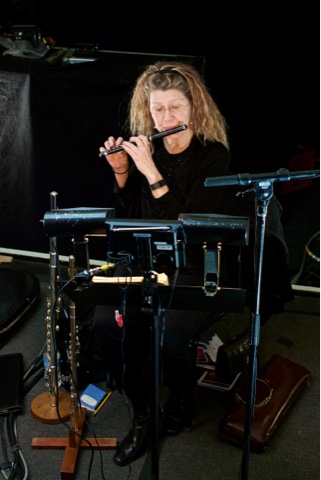
Kay Ragsdale and her Flutes

Kay Ragsdale and the flutes of The Lion King

It is with a heavy heart that I offer this tribute in memorium to one of the kindest and most generous people that I have known. Kay Ragsdale was a fine person and excellent flutist who loved her work and was happy to share her joy in her flute collection with anyone who was interested. It was more than a flute collection to her; it was a way of life. For every ethnic flute she owned she sought out a master to teach her the ways of the instrument. She learned not only how to play the flutes with their respective traditional techniques, but also their history and folklore. I will always cherish the time I spent with her, remembering her generous spirit, infectious laugh and amazing knowledge about flutes and cultures of the world.

This is a transcript of a lecture demonstration given by Kay Ragsdale, the flutist who travels with the Gazelle Tour of The Lion King. She has a magnificent collection of ethnic flutes from all over the world, as well as novelty flutes from different cultures and fascinating stories to go with the instruments. Not all the flutes she owns are played in the show. The Lion King flute book requires fifteen instruments (that’s a lot of doubling!) but she transports about 80 flutes in the instrument truck, some as back-ups in case a bamboo flute develops a crack, and some she carries with her so she can give demonstrations to groups in the cities where the show is playing. She offered to give a demonstration in Detroit when the show was at the opera house in 2008 and what follows are highlights from a transcription of the lecture she gave to the lucky few who were assembled there.

Kay also offered to any flute student the chance to sit with her during a show and experience The Lion King from the pit, an opportunity that two of my students took. It was a unique experience which they will always remember. At the end of the show she gave each of them a little clay bird ocarina which chirps when you put water in it and blow through the tail.

If you want to find out more about the flutes in The Lion King and see interviews with Kay Ragsdale, just go to You Tube and search for Kay Ragsdale, flutes.


Highlights from Kay’s lecture in Detroit:

“One of my favorite things, and I’ve actually had to use this, is a cane. It’s a walking stick flute. These were very popular in Victorian England. The Dayton C. Miller collection at the Library of Congress in Washington, D.C. has the largest collection of walking stick flutes of any country. Some had detachable piccolos and a bird whistle in the handle. Of course, only wealthy men had walking sticks but the women, not wanting to be left out, installed little music boxes in their bustles which would play their signature tune whenever they sat down. We do know that Queen Victoria’s bustle played “God Save the Queen” when she sat down.

“Now, of course you all know what this is - it’s a Nose flute. it has three holes so you only use one hand to finger the notes and with the other hand you close off the other side of your nose, if you need to change sides, then you change hands. Very practical. They make different sized flutes for different keys. While a lot of these cultures talk about the sacredness of the air the cultures that use nose flutes, such as Africa and in the South Pacific islands, believe the air you use through your nose is better than the air through your mouth because you can’t say anything bad about anybody with your nose.


“One of my favorite categories of flutes are clay vessel flutes known as Ocarinas.  They make nice necklaces when you put them on a string and wear them around your neck. An interesting period in Victorian England was when the Victorians thought they could teach baby birds how to sing better than the birds’ mothers. But it turned out that the whole experiment was a disaster. None of them learned their correct species song, none of them could attract a mate or reproduce and they all died. But what we have left from that are these little clay bird whistles which, when you put water in the hole in the top and blow through the hole in the tail, it chirps.

“You can always tell a Bansuri flute from India because they are not decorated. In ancient India a flutist dedicates his life to playing the flute. Now we use clocks but in ancient times the flute player  marked the passage of time by playing different sized flutes, starting out by playing the smallest flute before dawn and ending up by playing the largest flute at midnight. The largest one has about the range of our modern alto flute but without keys to help cover the holes. As the flutes get larger the holes get bigger and harder to cover as the spacing is more distant; so flute players were selected at a very young age and had the skin between the fingers cut so the fingers could stretch out as the flute player grew and their fingers would be able to cover the holes. (groans from the audience)

“Now let’s go to China. Chinese d’tzi were highly decorated.  They believe that the eye is to be delighted as well as the ear. They come in two colors, black and brown. Sometimes stories and poems are written on them as part of the decoration. In many cultures the flutes can be played to the right or the left. The right and left hands are in the same position so you can play it in either direction. Hand position is different than modern western flute; balance points are the chin and each thumb, not the cradle position that we use. There is an extra hole between the embouchure hole and finger holes where you place a membrane, called dimo, made from the interior of a bamboo plant. It's like very fragile tissue paper and causes it to sound like a kazoo. You can place the grain either horizontally or vertically over the hole, traditionally sticking it on with a bit of garlic juice. The d’tzi are smoked and when you get a new one they smell like ham. To maintain these instruments you need to treat them with mustard seed oil.  So, with ham, mustard and garlic, depending on their preference for lunch, your friends might want to sit closer to you or farther away. 

“Now we will go from China to Japan: the national flute of Japan is the shakuhachi. The name comes from ‘shaku’ which was a unit of measurement – originally it was one growing season of the bamboo from which it is made,  which can vary from year to year depending on the growing conditions. Each node represents one growing season and the bottom end of the shakuhachi is the bulbous root. Shakuhachi belongs to the notched flute family; it has five finger holes and plays the pentatonic scale. It is not decorated on the exterior as the Chinese flutes are but beautifully lacquered on the interior.  That is because the Japanese believe that spirits live inside the flute. In fact, you bring the spirits back to life every time you play. Additionally, the air you use is not yours to take at will but given to you as a gift by all those who have gone before. So it’s a heavy weight of responsibility to do one’s best with the air that is given to you only temporarily. After you play a phrase you must then audibly replace the air that you borrowed as a ‘thank-you’. In the show, you are required to follow these rituals if it applies to that country’s instrument.  

“Only the samurai warriers were allowed to play the shakuhachi.  Women and children were not allowed to touch it. Ordinary men were not allowed to touch it either. The samurai studied two things: sword and flute because they shared two elements - breathing and concentration. In battle if you were to lose your sword, you could whip out your flute and use it as a club against your opponent. 

“The ancient Greek mythological figure, Pan was half man, half goat. One day he was chasing after the wood nymph Syrinx, who wisely ran to the river’s edge where she implored the river god to help her and was changed into a reed, along with her sisters. Not being able to find her, Pan was very disconsolate so he gathered some reeds by the river and cut them into different lengths. He then made the instrument which we call the Pan Pipe and he brought Syrinx back to life by blowing across the edge of the tubes. The ultimate tragedy was that Pan killed that which he loved the most, but do not despair because every time someone plays on a pan flute, Syrinx will be brought back to life.

 “Lion King has the greatest flute part ever. I look forward to playing the show every day. I get nervous before every show and at the end I say, “That was really fun, let’s do it again!” so I get another chance to play it. That’s the great thing about it - you get the chance to play multiple repetitions. One thing I've learned is to never give up or get dissuaded by anything anyone says. I didn’t listen to anyone when they told me I couldn't do it. If you’re interested in something, just explore it on your own.”

After about an hour and a half of fascinating flute lore, we ran out of time for Kay to show us her crystal flute and many others, I suspect, but we came away with her deep love for what she does and her generosity of spirit in sharing her passion with others.

RIP, Kay and thank-you for enriching the world with everything you have given us.


Sunday, February 28, 2016

Cinderella's Pit

"Cinderella" February 16-28 at the Detroit Opera House

The orchestra pit for the national tour of Cinderella has become my home away from home these last two weeks. We’re in there for eight magical shows a week so most of us have carved out our own personal space amongst the music stands and lights, microphones and cables, video and audio monitors, cases and cameras. It can be a hazardous place to walk; it’s dark in the pit, there are wires and cables everywhere and we could hit our heads on the conductor’s camera hanging from under the stage. We have been very lucky so far, in part because the company has marked off some of these areas with bright green duct tape and, with only fourteen musicians in the pit, we have a lot more room than usual.

When you’re at work six days a week the tendency is to camp out in your space. It’s very clear where my space is. In addition to the flute stands for my various instruments (flute, piccolo and alto flute), I keep a water bottle and tea cup, heating pad for when the air conditioning is on, instrument cozies to keep the flutes warm and protected when I leave the pit, something to read, and a knitting bag. I also have a couple sweaters of different weights for the widely varying temperatures in the Detroit Opera House pit.

I like to arrive about 45-60 minutes before show time. It’s a good time to sit in my own little corner and play long tones, tune each instrument with the tuner, warm up with scales and other warm-up exercises, look over the music for the show and maybe bring something else to practice. By that time other musicians have arrived and we have a friendly chat or teasing banter, whatever the case may be. Lately there has been discussion about the presidential primaries and some predictions of who will win the nominations. I heard a rumor about a little town in Canada that’s losing population and is mounting an ad campaign to lure Americans in case Trump is elected (!). Tonight, I was informed of the difficulties and frustrations in finding a good clarinet reed. After catching up with my colleagues I’ll walk around, get a cup of tea, see if anyone brought yummy snacks to the orchestra room, return to the pit and settle in for the show.

A few nights ago almost everyone arrived early. A bad storm was predicted and we were warned to allow extra time. Sure enough, a portion of the highway was flooded and I had to find an alternate route. I still got there over an hour early. Of course, the show must go on and I’m sure the 400 or so audience members who decided to brave the storm were rewarded for their intrepidity.

It’s interesting to gauge the audience’s reactions to the show. They are quite predictable; at various points the audience always laughs. They sometimes applaud the prince when he stands up to his bullying advisor (but we can’t figure out why some audiences have no reaction at all). When the actors use funny voices, the children laugh. Children’s shows always throw in some adult humor as well. It’s best when you hear lines in context but I’ll give you a few that always get a laugh:

Cinderella after being told the nice man she just met is the future king: “That man a world leader? But he appears to have a heart, mind and soul!”

Fairy Godmother after she magically transforms from a beggar: “You’d be surprised how many beautiful gowns have crazy women in them.”

One of the stepsisters (the nice one) talking about her mother: “Madame isn’t always so terrible – sometimes she sleeps.”

Cinderella, who always has a kind word, commenting about her nice but goofy stepsister’s boyfriend: “He is a good man and seems angry for all the right reasons.”

The boyfriend to the stepsister when he picks her up for their date to go help out at the soup kitchen (!?!): “I much prefer you in this simple attire – you no longer look like a carnival attraction.”

As you can see, the production has been updated and modernized for today’s audiences. What you can’t see from this description is how the show as a whole comes across. It appeals to a wide demographic. I thought I would see primarily families with young children but, although every audience has its fair share of little girls wearing sparkly dresses and tiaras, there is a pretty good cross section of the general population at every performance. Last night as I was leaving the hall I saw a group of youngish to middle aged ladies posing for a picture on the sidewalk - they were all wearing tiaras.

What brings people to this show and what do they leave with? Well, joy for one thing. Everyone looks pretty joyful as they walk to the parking garage after the show. I sure am. Every night. The music is infectious, especially the dance sequences. The waltz at the end of the first act and the soft shoe number in the second act are just as fun in the pit as they are on stage. The conductor checks the metronome at every performance for some crucial numbers. At the right tempo the beautiful gowns at the ball look like jelly fish on the lifts and open up like parachutes when they come down. I have to take the conductor’s word for that because I can’t see a thing. I also can’t hear much of what is happening on stage when the band is playing and we are playing most of the time. In fact, I am so busy switching from piccolo to flute to alto flute and turning pages at the same time, I hardly have time to think of anything else but what is coming around the next corner.

A positive feeling is engendered throughout the production team of Cinderella. The theme of the show seems to cover kindness, compassion and forgiveness. The audience gets that from Cinderella’s character but what they don’t see is the character of the people in the pit. The musicians who travel with the show - a conductor, keyboard 1 and keyboard 2/assistant conductor – are still engaged after many months of touring in a different city every week or two by taking notes and discussing ways to improve the music.  They have traditions which they share with the home band - they mark the place and make a memory of each city by taking a band picture during intermission of the first Sunday matinee; they invite the local musicians to join them for bagels, cream cheese and coffee on Sunday; they also invite us to join in their tradition of wearing tiaras for the Sunday performances.

photos by David Ammer
It is a custom in touring companies on Friday nights to sell raffle tickets backstage for a 50/50 raffle. Half goes to the winner and the other half goes to a charity. The Cinderella team has decided to support The Trevor Project, a teen suicide prevention organization.

Another way in which the conductor engenders positive feelings is by handing out compliments generously. She tells us after every show, “Excellent show!” and occasionally approaches individual members to tell them something specific that she likes about their playing. She smiles at me when I play my favorite alto flute solo (I missed it one night because of a page turn gone wrong and she started singing my part), dances along to the music, reacts to things that happen on stage and talks to the audience during the exit music, even allowing a little tiara-wearing girl to conduct us after one performance! One more very thoughtful thing about this conductor is that she invites us, one at a time, during the only long dialog scene to stand by her podium to watch that little portion of the show.

I’ll miss Cinderella when it goes on to Fayetteville, Tulsa, Appleton and beyond . . . but it closes this May so if you want to see it, you’d better hurry! Now I’m off to buy my tiara.


Tuesday, February 23, 2016

In the Pit of a Touring Broadway Show


    Occasionally the musicians in the pit of the Detroit Opera House are called upon to play for touring companies of Broadway shows and, less frequently, one of the woodwind books includes strictly flute doubles, meaning that whoever plays that book only has to play flute, piccolo, sometimes alto flute and, at times, recorder.  Usually the woodwind books include instruments that most legit flute players don’t play, like saxophone and clarinet. I have fond memories of playing shows such as Man of La Mancha, Carousel, Mary Poppins, Peter Pan, Music Man and Phantom of the Opera, to name a few.
    In the days before electronic keyboards there used to be full orchestras in the pit but now the shows usually travel with a conductor, two keyboard players who round out the orchestra with sampled sounds of strings, harp, oboe, bassoon and whatever else they need, one doubling as assistant conductor (so the conductor can have one show off out of 8 shows per week), and, depending on the show, possibly a trumpet player, guitarist or percussionist. In Lion King, for example (my favorite show) the flutist travels with the show, carrying along numerous members of the flute family, including all sizes of ethnic flutes to make the show sound more authentically African. The audition process for this show is grueling – the flutist practically has to be a professional pan pipe player as well as other end-blown and transverse bamboo flutes– and a very few have devoted their professional careers to travelling with the various touring productions of Lion King.
    I have enjoyed meeting the travelling musicians in these shows and I admire their patience in teaching us the books they know so well, every week or two a new batch of musicians in a new town. Again, Lion King stands out for the generosity and humanity of the flutist who has been to Detroit at least twice. Kay Ragsdale not only plays and takes care of the many flutes she plays in the show (I think it’s 15!), she also has her own personal collection of ethnic flutes which she keeps in a large trunk that travels with the show’s equipment. She offered to give a demonstration to any interested flutists and students while the show was in town so I put together an assembly of locals and she literally gave us a tour of the flute ‘world’ with demonstrations, stories and myths accompanying all the various flutes in her collection. It was fascinating! If you want to know more, just google Kay Ragsdale, Lion King flutes.
    Not only did Kay take much of her free time to give us the demonstration but she offered to let one student at a time sit in the pit with her during a show and watch over her shoulder as she played. Two of my students took advantage of her generous offer and so did I! This behind-the-scenes peek into the life of a pit musician was inspiring for them. She also gave each of them a gift – a hollow clay bird that you play like a whistle and, when you put a little water in its belly, it chirps and warbles like a real bird.
    Kindness and generosity abound in these touring companies. When Mary Poppins was in town, Nicolas Dromard, the actor who played Bert the chimney sweep (who, by the way, walks upside down across the proscenium during the big “Step in Time” dance number), came into the pit before one of the shows and introduced himself to me. As it happens, he played the flute and liked to meet the flute players in all the towns where they played with hopes that they might want to play duets sometime.  That opportunity came and we got together a few times to play duets and talk flutes. He had a lovely flute and we had fun playing duets. I brought a few of the books in my collection of flute duets from Mozart operas and mentioned in passing that I had lost my favorite one, duets from the Magic Flute. To my surprise, not long after that I received a new copy of the Magic Flute duets with a sweet note from him. Not only kind and generous, but thoughtful too.

    As I write this, I am in the middle of playing two weeks with the National Tour of “Cinderella”. We have one day off, then eight more magical shows. I’ll write about that in my next post.