Showing posts with label orchestra pit. Show all posts

Thursday, February 9, 2017

Preparing for Phantom of the Opera


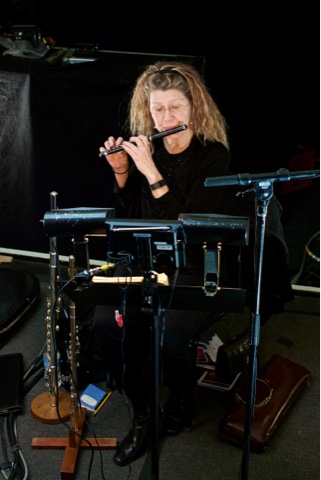
My setup with monitor
If you’ve ever wondered how the musicians prepare for an upcoming show, how many rehearsals they have, and that sort of thing, read on.

Recently Phantom of the Opera came to town, a fabulous show that I have played once before at the Detroit Opera House and one in which I was looking forward to playing again. The show travels from one city to another, bringing with it four musicians and two conductors. Much of what the audience hears coming out of the pit is in the three keyboards, each with sampled sounds of instruments we don’t have live such as oboe, percussion, string section and, in the case of Phantom, the infamous organ. There is a pre-recorded actual pipe organ which is very impressive at the beginning of the show when it fills the theater with its massive sound. As for the live instruments, there are six local string players and five winds – flute, clarinet, bassoon, horn and a doubler on clarinet and flute.

The opera musicians are first call, starting with the principals. I only get to play if the principal player isn’t available and if the book only includes instruments which I play (flute, piccolo, alto flute, recorder). So, for example, if the flute book includes doubles on clarinet or saxophone, I wouldn’t be able to play.

Wind section for Phantom

We are hired usually a few months ahead and are given an advance book for practicing a few weeks before the first rehearsal. They include metronome markings so we can practice at the right tempo and ‘heads up’ indications for tricky places. In the last few years the advance book has included a DVD of the conductor in the pit conducting the show so we can follow along and get a feel for how the show runs. These tips are very helpful.

At the first rehearsal we trade in our practice books for the real thing, which remains with the show’s librarian or on our stands in the pit. They never allow the actual book to go home with the musicians.  This is the book that travels with the show and contains helpful markings by the people who have played it in previous cities. On the last page it is traditional to sign your name, date and place.  It’s fun to see who has played that particular book before, and I usually know at least one person who has signed it.

signature page
To illustrate a useful application of this practice, many years ago I was playing Peter Pan in Toledo and got sick. I noticed from the signatures at the back of the book that a friend of mine nearby had played the show a few months before so they were able to call her to sub for me. Although it worked out for me at the time, I haven’t been called for Toledo since. Unfortunately, musicians can’t afford to get sick. We don’t get paid to take sick days either. But, I digress.

Back to the pit. Or, I should say, the rehearsal room because that is where the first rehearsal is held. The stage and pit are usually still being set up for opening night so are inaccessible to us. In the case of Phantom, our first rehearsal was Tuesday evening.  We met the six travelling musicians and they learned all of our names in a flash – impressive because there were eleven of us. As the locals got to know the travelling musicians who tour with the show, new friendships developed. One of the keyboard players recognized me from the last time we did Phantom and everyone was playing the “do you know so-and-so?” game.

 The conductor was very efficient and pleasant and the time flew by. We almost made it through the whole show but luckily we had another orchestra rehearsal the next day. For some shows we only have one rehearsal on the morning of the day it opens. Then there’s the sound check which begins two hours before curtain and lasts about an hour. At the sound check the sound crew tests each musician’s microphone level on each instrument they play. This is time for us to either run through scales and doodle around or show off with fancy excerpts or a tune from the show. Then the lead singers come onstage, usually look into the pit and say ‘hello’, and we play a bit of one of their songs. That’s the first time we hear the singers. 

After the sound check we have an hour to kill before opening night. We are all on the edges of our seats, concentrating 1000% on doing everything right for the first few performances, until it becomes more comfortable. Although the conductor warned us at the rehearsal about some of the special effects, it was a shock at the opening night performance when jets of fire shot up from the stage, blinding us and searing us with the heat. It was so distracting that I missed my cue at the first couple performances. Just when we begin to feel more confident, the assistant conductor comes in to conduct a show and we get nervous all over again. With eight shows a week, the conductor needs some time off.  Luckily both conductors for Phantom were very good and gave us our cues.

There is always a camera on the conductor for back stage monitors as well as little individual monitors for anyone in the pit who doesn’t have a great view of the conductor. I used a monitor during Phantom because the podium was so high and I was so close to the conductor, I would have had a stiff neck from looking up so much every night. It’s important to look at the conductor because, even with a show that is very predictable there can be surprises. There are also a few places where the conductor has to put ear buds in his/her ears to listen for a click track to coordinate the pit and stage (and sometimes the backstage chorus) with a recording.

By the end of the first week we are confident that we know the show and are ready for a night off.  Monday is traditionally dark in a theater. It’s also a good time to catch up on things at home we’ve let slide because of the busy schedule.  I used my day off to go to a yoga class and get a massage. Did I play my flute or piccolo that day? Well, what would you have done?


Unflattering selfie with the famous chandelier


Monday, March 21, 2016

A View from the Pit

Heinz Prechter Educational and Performing Arts Center at WCCC

The final weekend performances of MOT’s production of Aaron Copland’s The Tender Land were held at a very interesting venue, the Heinz Prechter Educational and Performing Arts Center in Taylor, MI. It’s the first time the company has presented there and, according to CEO Wayne Brown’s opening remarks, it won’t be the last.

My first impression was favorable. It looks like a very new performing arts hall but I was told it’s been there for a number of years. As I drove in from Northline Rd. the architecture of the building welcomed me with open arms and the glass façade gave an inviting effect. Inside the back stage area was spacious and clean – unbelievably so. Someone provided signs directing us to the pit which was so low that a platform had to be built for the orchestra and, even with a podium, the conductor’s head couldn’t be seen from the audience. After coming from the Macomb Center the sound was surprisingly complimentary and friends in the audience said the orchestra sounded great.


My view of the stage from the pit

It was generally agreed in the orchestra pit that, although we enjoyed the music from Copland's opera, we are glad it’s over. The orchestra parts were reduced from a full orchestra to a small chamber ensemble of 13 musicians and we had to carry the backup for the singers for a little over two hours.  It wouldn’t have been so bad if we had had an intermission between acts 2 and 3 but, perhaps in order to save time, they decided to combine the second and third acts into one 60-minute act. It was a killer for some of the musicians. A few of us were complaining about our rotator cuffs, there was a bad back or two and arms were practically falling off by the end of every performance. Maintaining concentration was also a challenge when you're playing constantly, as was balance in volume between pit and stage. We were frequently given “the hand” (shhh – play softer!) and I was heard proclaiming that “I’ve never played so softly in my life!” The clarinetist and I were comparing notes on how our embouchures were unable to produce a decent sound anymore and I felt a kindred spirit with marathon runners as they collapse at the end of a race.  

Now we have a much needed week off before rehearsals start for the ballet, The Sleeping Beauty with the American Ballet Theater from New York. I have to switch gears from flute to piccolo and Copland to Tchaikovsky – a marathon to a series of sprints. At least in ballet we don’t have to worry about playing softly all the time so the singers can be heard.

Sunday, February 28, 2016

Cinderella's Pit

"Cinderella" February 16-28 at the Detroit Opera House

The orchestra pit for the national tour of Cinderella has become my home away from home these last two weeks. We’re in there for eight magical shows a week so most of us have carved out our own personal space amongst the music stands and lights, microphones and cables, video and audio monitors, cases and cameras. It can be a hazardous place to walk; it’s dark in the pit, there are wires and cables everywhere and we could hit our heads on the conductor’s camera hanging from under the stage. We have been very lucky so far, in part because the company has marked off some of these areas with bright green duct tape and, with only fourteen musicians in the pit, we have a lot more room than usual.

When you’re at work six days a week the tendency is to camp out in your space. It’s very clear where my space is. In addition to the flute stands for my various instruments (flute, piccolo and alto flute), I keep a water bottle and tea cup, heating pad for when the air conditioning is on, instrument cozies to keep the flutes warm and protected when I leave the pit, something to read, and a knitting bag. I also have a couple sweaters of different weights for the widely varying temperatures in the Detroit Opera House pit.

I like to arrive about 45-60 minutes before show time. It’s a good time to sit in my own little corner and play long tones, tune each instrument with the tuner, warm up with scales and other warm-up exercises, look over the music for the show and maybe bring something else to practice. By that time other musicians have arrived and we have a friendly chat or teasing banter, whatever the case may be. Lately there has been discussion about the presidential primaries and some predictions of who will win the nominations. I heard a rumor about a little town in Canada that’s losing population and is mounting an ad campaign to lure Americans in case Trump is elected (!). Tonight, I was informed of the difficulties and frustrations in finding a good clarinet reed. After catching up with my colleagues I’ll walk around, get a cup of tea, see if anyone brought yummy snacks to the orchestra room, return to the pit and settle in for the show.

A few nights ago almost everyone arrived early. A bad storm was predicted and we were warned to allow extra time. Sure enough, a portion of the highway was flooded and I had to find an alternate route. I still got there over an hour early. Of course, the show must go on and I’m sure the 400 or so audience members who decided to brave the storm were rewarded for their intrepidity.

It’s interesting to gauge the audience’s reactions to the show. They are quite predictable; at various points the audience always laughs. They sometimes applaud the prince when he stands up to his bullying advisor (but we can’t figure out why some audiences have no reaction at all). When the actors use funny voices, the children laugh. Children’s shows always throw in some adult humor as well. It’s best when you hear lines in context but I’ll give you a few that always get a laugh:

Cinderella after being told the nice man she just met is the future king: “That man a world leader? But he appears to have a heart, mind and soul!”

Fairy Godmother after she magically transforms from a beggar: “You’d be surprised how many beautiful gowns have crazy women in them.”

One of the stepsisters (the nice one) talking about her mother: “Madame isn’t always so terrible – sometimes she sleeps.”

Cinderella, who always has a kind word, commenting about her nice but goofy stepsister’s boyfriend: “He is a good man and seems angry for all the right reasons.”

The boyfriend to the stepsister when he picks her up for their date to go help out at the soup kitchen (!?!): “I much prefer you in this simple attire – you no longer look like a carnival attraction.”

As you can see, the production has been updated and modernized for today’s audiences. What you can’t see from this description is how the show as a whole comes across. It appeals to a wide demographic. I thought I would see primarily families with young children but, although every audience has its fair share of little girls wearing sparkly dresses and tiaras, there is a pretty good cross section of the general population at every performance. Last night as I was leaving the hall I saw a group of youngish to middle aged ladies posing for a picture on the sidewalk - they were all wearing tiaras.

What brings people to this show and what do they leave with? Well, joy for one thing. Everyone looks pretty joyful as they walk to the parking garage after the show. I sure am. Every night. The music is infectious, especially the dance sequences. The waltz at the end of the first act and the soft shoe number in the second act are just as fun in the pit as they are on stage. The conductor checks the metronome at every performance for some crucial numbers. At the right tempo the beautiful gowns at the ball look like jelly fish on the lifts and open up like parachutes when they come down. I have to take the conductor’s word for that because I can’t see a thing. I also can’t hear much of what is happening on stage when the band is playing and we are playing most of the time. In fact, I am so busy switching from piccolo to flute to alto flute and turning pages at the same time, I hardly have time to think of anything else but what is coming around the next corner.

A positive feeling is engendered throughout the production team of Cinderella. The theme of the show seems to cover kindness, compassion and forgiveness. The audience gets that from Cinderella’s character but what they don’t see is the character of the people in the pit. The musicians who travel with the show - a conductor, keyboard 1 and keyboard 2/assistant conductor – are still engaged after many months of touring in a different city every week or two by taking notes and discussing ways to improve the music.  They have traditions which they share with the home band - they mark the place and make a memory of each city by taking a band picture during intermission of the first Sunday matinee; they invite the local musicians to join them for bagels, cream cheese and coffee on Sunday; they also invite us to join in their tradition of wearing tiaras for the Sunday performances.

photos by David Ammer
It is a custom in touring companies on Friday nights to sell raffle tickets backstage for a 50/50 raffle. Half goes to the winner and the other half goes to a charity. The Cinderella team has decided to support The Trevor Project, a teen suicide prevention organization.

Another way in which the conductor engenders positive feelings is by handing out compliments generously. She tells us after every show, “Excellent show!” and occasionally approaches individual members to tell them something specific that she likes about their playing. She smiles at me when I play my favorite alto flute solo (I missed it one night because of a page turn gone wrong and she started singing my part), dances along to the music, reacts to things that happen on stage and talks to the audience during the exit music, even allowing a little tiara-wearing girl to conduct us after one performance! One more very thoughtful thing about this conductor is that she invites us, one at a time, during the only long dialog scene to stand by her podium to watch that little portion of the show.

I’ll miss Cinderella when it goes on to Fayetteville, Tulsa, Appleton and beyond . . . but it closes this May so if you want to see it, you’d better hurry! Now I’m off to buy my tiara.


Tuesday, February 23, 2016

In the Pit of a Touring Broadway Show


    Occasionally the musicians in the pit of the Detroit Opera House are called upon to play for touring companies of Broadway shows and, less frequently, one of the woodwind books includes strictly flute doubles, meaning that whoever plays that book only has to play flute, piccolo, sometimes alto flute and, at times, recorder.  Usually the woodwind books include instruments that most legit flute players don’t play, like saxophone and clarinet. I have fond memories of playing shows such as Man of La Mancha, Carousel, Mary Poppins, Peter Pan, Music Man and Phantom of the Opera, to name a few.
    In the days before electronic keyboards there used to be full orchestras in the pit but now the shows usually travel with a conductor, two keyboard players who round out the orchestra with sampled sounds of strings, harp, oboe, bassoon and whatever else they need, one doubling as assistant conductor (so the conductor can have one show off out of 8 shows per week), and, depending on the show, possibly a trumpet player, guitarist or percussionist. In Lion King, for example (my favorite show) the flutist travels with the show, carrying along numerous members of the flute family, including all sizes of ethnic flutes to make the show sound more authentically African. The audition process for this show is grueling – the flutist practically has to be a professional pan pipe player as well as other end-blown and transverse bamboo flutes– and a very few have devoted their professional careers to travelling with the various touring productions of Lion King.
    I have enjoyed meeting the travelling musicians in these shows and I admire their patience in teaching us the books they know so well, every week or two a new batch of musicians in a new town. Again, Lion King stands out for the generosity and humanity of the flutist who has been to Detroit at least twice. Kay Ragsdale not only plays and takes care of the many flutes she plays in the show (I think it’s 15!), she also has her own personal collection of ethnic flutes which she keeps in a large trunk that travels with the show’s equipment. She offered to give a demonstration to any interested flutists and students while the show was in town so I put together an assembly of locals and she literally gave us a tour of the flute ‘world’ with demonstrations, stories and myths accompanying all the various flutes in her collection. It was fascinating! If you want to know more, just google Kay Ragsdale, Lion King flutes.
    Not only did Kay take much of her free time to give us the demonstration but she offered to let one student at a time sit in the pit with her during a show and watch over her shoulder as she played. Two of my students took advantage of her generous offer and so did I! This behind-the-scenes peek into the life of a pit musician was inspiring for them. She also gave each of them a gift – a hollow clay bird that you play like a whistle and, when you put a little water in its belly, it chirps and warbles like a real bird.
    Kindness and generosity abound in these touring companies. When Mary Poppins was in town, Nicolas Dromard, the actor who played Bert the chimney sweep (who, by the way, walks upside down across the proscenium during the big “Step in Time” dance number), came into the pit before one of the shows and introduced himself to me. As it happens, he played the flute and liked to meet the flute players in all the towns where they played with hopes that they might want to play duets sometime.  That opportunity came and we got together a few times to play duets and talk flutes. He had a lovely flute and we had fun playing duets. I brought a few of the books in my collection of flute duets from Mozart operas and mentioned in passing that I had lost my favorite one, duets from the Magic Flute. To my surprise, not long after that I received a new copy of the Magic Flute duets with a sweet note from him. Not only kind and generous, but thoughtful too.

    As I write this, I am in the middle of playing two weeks with the National Tour of “Cinderella”. We have one day off, then eight more magical shows. I’ll write about that in my next post.

Monday, February 8, 2016

Playing Piccolo in the Opera Orchestra

May 17, 2015

I'm excited to post my first blog post here today. It has taken me since last May to get around to it, so that explains the discrepancy in dates. Well, here it goes! I hope you like it.


How many people can say they love their job?  I count myself among the lucky ones who are absolutely enthralled with what they do.  When I go to work all the cares of the world melt away and I am transported to a place where my heart is filled with beauty.  I don’t go there alone, either.  Fifty or so of my colleagues in the pit and another group of approximately that number or more on the stage, along with hundreds of audience members, are taken to that place too, transported by the music of opera.  I am an opera musician and I have the best job in the world!

Throughout Michigan Opera Theater’s run of Gounod’s Faust, we have had one glorious performance after another.  The soloists of both casts are awe-inspiring, the chorus is brilliant, and the conductor brings power and freedom to the score, allowing the musicians to play with their hearts (but more about conductors in another post). 

Usually by the second weekend of the run we are on auto-pilot.  It takes a couple dress rehearsals, opening night and one more performance to get to the point where we know what to expect, then it’s just “relax and have fun”. 

Ha!  It’s nice when it works that way but the life of a piccolo player is sometimes fraught with terror.  Most of the time I sit there, counting rests, trying to stay awake.  Sometimes I tacet a whole number, in which case I can close my eyes and wait for the applause to wake me up and start paying attention again.  As I am the only piccolo player in the orchestra, if I come in on a rest or play a wrong note it is obvious who made that mistake.  I will undoubtedly get a dirty look from the conductor.  There is nothing like fear to make you stay awake.   Part of the life of a piccolo player in the pit is spent trying to stay awake and another part is spent in sheer terror waiting for a big exposed solo with a cold, temperamental instrument, not completely comfortable with what is going to come out when it’s time to play.  The rest of the time is great fun.

One of those fun moments in Faust is during the dance at the end of Act II when the orchestra is playing a rousing waltz and we can only imagine what is happening on stage.  I imagine a crowded ballroom with dancers and I want to get up and join them.  The music lifts me out of my chair and transports me to the ballroom where I am swept off my feet by one of the handsome dancers and I am twirling around the dance floor in a beautiful costume . . . time to wake up!  There is actually no time to daydream during the waltz.  The orchestra is very busy creating the ambiance for the dancing and it is one of the times when we can really open up and play.  So much of the time in opera we have to play very quietly so we don’t cover the singers but there is always a dancing scene in French opera so the orchestra switches gears from opera to ballet.  I must confess that I love to play waltzes, even the “Waltz of the Flowers” in the Nutcracker ballet - that much maligned waltz that orchestra musicians love to hate because of its repetitive nature.  I love it because it builds with each repetition until it reaches the climax.

The second waltz in Faust is also fun to play.  It is the famous “Jewel” aria which Marguerite sings after Mephistopheles leaves her a box of jewels.  It features the two flutes in little duet vignettes, a very dainty and feminine aria but a show stopper for the soprano.

I can’t talk about Faust without mentioning my favorite aria and one of the most beautiful tenor arias of all time, “Salut, demeure chaste et pure”.  It is pure magic and we had a chance to hear two wonderful tenors sing it because the show was double-cast.  The tenor who sang the final performance is a star of the popular singing group, Il Divo.  His name is David Miller and I was a fan before he became an international sensation.  I don’t know why I remembered his name, it’s such a common-sounding American name, but I remember his voice singing Lenski’s aria in Eugene Onegin many years ago.  It ripped my heart out with its passion and poignancy.  He came back a few years ago to sing Tamino in The Magic Flute, another memorable performance.  In Faust’s aria, he did not disappoint.

Sitting in the pit at such times can be quite frustrating.  I want to see what is going on and watch the singers but it’s impossible from where I sit just under the lip of the stage where, if they were using stage fog, it would fall right on top of me.  As a matter of fact, when they turn on the air conditioning, the breeze coming down from the stage is so strong, it turns our pages for us – at all the wrong times!

Occasionally I can hear that the singers are at the downstage edge and I can twist around to see the tops of their heads.  Last Sunday was one such occasion.  As I heard the voices getting closer to the edge of the stage, I leaned forward and looked up.  It was exciting to see David Miller with his mouth wide open, singing his heart out.  There was something else interesting about seeing opera from my unique vantage point - I am probably one of the few people who can say they have looked into David Miller’s nostrils!